
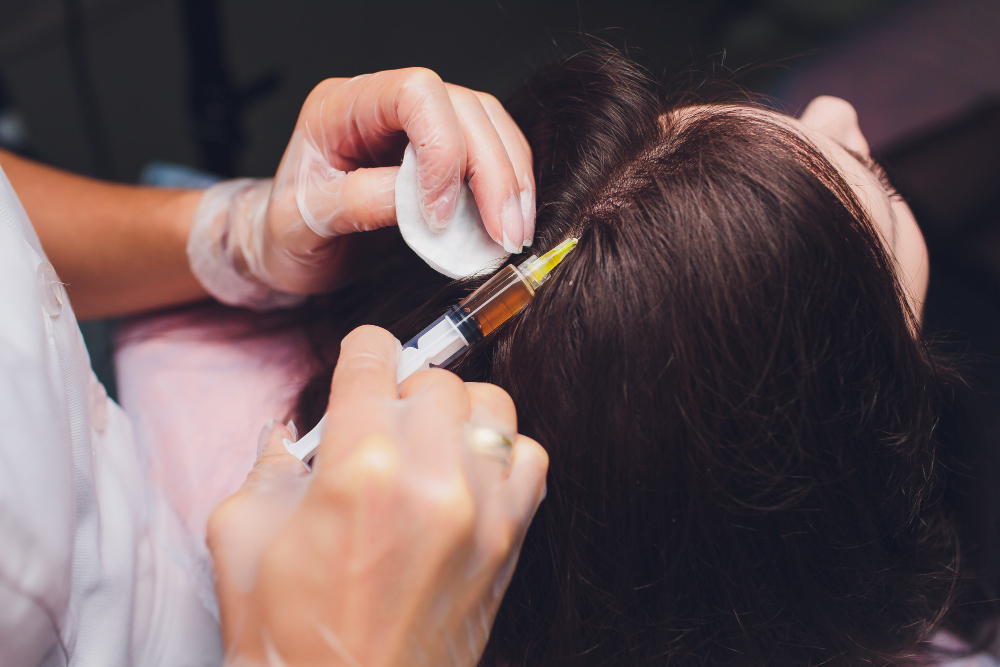
Hair PRP Therapy for Hair Restoration
Experiencing thinning hair or hair loss? Platelet-Rich Plasma (PRP) therapy offers a safe, non-surgical solution that uses your body’s own natural growth factors to stimulate hair regrowth — with no downtime and no synthetic drugs. At Connecticut Pain Solutions, Dr. Igor Turok provides hair PRP therapy to patients throughout Wallingford, Ridgefield, and the surrounding Connecticut communities.
What Is PRP Hair Restoration Therapy?
Platelet-Rich Plasma (PRP) for hair loss is a cutting-edge, non-surgical treatment that harnesses the concentrated healing growth factors in your own blood to revive dormant hair follicles and promote thicker, fuller regrowth. A small blood sample is drawn, processed to isolate the platelet-rich plasma, and then injected into the scalp at the areas of thinning or loss.
PRP has been used across multiple medical specialties for decades — including orthopedics, wound healing, and cosmetic medicine — and has established a strong track record in hair restoration for both men and women.
How PRP Works for Hair Regrowth
The PRP hair restoration process is simple, quick, and highly effective:
Step 1 — Blood Draw: A small amount of your blood is drawn, similar to a routine lab test.
Step 2 — PRP Processing: Your blood is placed in a centrifuge that spins rapidly to separate the platelets from the red and white blood cells — concentrating the growth factors.
Step 3 — Scalp Injection: The concentrated PRP is injected into targeted areas of the scalp where thinning or hair loss is occurring.
The platelets contain powerful growth factors — including PDGF, VEGF, and IGF — that stimulate and accelerate the hair follicle’s natural growth cycle, promoting new hair growth and improving the health and thickness of existing hair.
Benefits of PRP for Hair Loss
PRP therapy for hair loss delivers a range of advantages over surgical and pharmaceutical alternatives:
Non-Surgical — No cuts, no scalpels, no scarring, and no general anesthesia.
Natural Results — Uses your body’s own growth factors for genuine, lasting regrowth.
Quick Treatment — Each session takes only about 30 to 45 minutes, making it easy to fit into a busy schedule.
Minimal Downtime — Most patients resume normal activities immediately after treatment.
Proven & Safe — PRP is a well-established treatment with extensive clinical use across multiple specialties.
Works for Men and Women — Effective for androgenetic alopecia and other causes of hair thinning in both sexes.
Who Is a Good Candidate for Hair PRP Therapy?
PRP therapy is most effective for patients experiencing early to moderate hair thinning or hair loss. It works particularly well for individuals with androgenetic alopecia (pattern baldness), thinning caused by hormonal changes, postpartum hair loss, and stress-related shedding.
PRP is suitable for both men and women who want to restore their hair without surgery, implants, or pharmaceutical side effects. The best candidates are those whose hair follicles are still active — even if reduced — as PRP works by stimulating and reactivating follicles rather than creating new ones.
Not sure if you qualify? Our team at Connecticut Pain Solutions offers personalized consultations to assess your hair loss pattern and determine whether PRP therapy is the right solution for you.
What to Expect: Treatment Timeline
Most patients see meaningful improvement after a series of 3 to 4 treatments spaced approximately four weeks apart. Following the initial series, maintenance sessions every 6 to 12 months help sustain and build on results. Hair regrowth is progressive — patients typically begin noticing changes in texture and density within 2 to 3 months, with continued improvement over the following months.
Hair PRP therapy pairs well with other hair restoration strategies, including Hormone Replacement Therapy (HRT) for patients whose hair loss is hormonally driven. Our team will design a comprehensive plan tailored to your unique situation.
Frequently Asked Questions About Hair PRP Therapy
Is PRP therapy safe for hair restoration?
Yes. PRP uses your own blood, so the risk of allergic reaction, infection, or rejection is extremely low. The procedure is well-tolerated and has a well-established safety profile across a wide range of medical applications, including hair restoration.
How many PRP hair treatments will I need?
Most patients benefit from 3 to 4 initial treatment sessions spaced about one month apart, followed by maintenance treatments every 6 to 12 months. The exact number depends on the degree of hair loss and how your scalp responds to treatment — Dr. Turok will provide a personalized plan after your consultation.
Is the PRP hair restoration procedure painful?
A topical numbing agent is applied to the scalp prior to the injections to minimize discomfort. Most patients describe the treatment as very tolerable. Some mild tenderness or a sensation of pressure during injection is normal and typically brief.
How long does a PRP hair treatment session take?
Each PRP hair restoration session typically takes about 30 to 45 minutes from blood draw to completion. There is no recovery period required, and most patients return to their regular activities immediately.
When will I start seeing results from PRP hair therapy?
Most patients begin noticing improvements in hair texture, thickness, and reduced shedding within 2 to 3 months of their first treatment. Visible regrowth is typically more apparent after completing the full initial series of 3 to 4 sessions.
Can PRP hair therapy be combined with other treatments?
Yes. PRP can be combined with other approaches including hormone replacement therapy (for hormonally driven hair loss), topical treatments, and nutritional supplementation. Our team will help you understand which combination is most appropriate for your type of hair loss.
Does PRP work for all types of hair loss?
PRP is most effective for androgenetic alopecia (male and female pattern baldness) and thinning caused by hormonal changes, stress, or nutritional deficiencies. It is less effective for conditions involving complete follicle destruction (such as advanced scarring alopecia). A consultation with Dr. Turok will help determine whether PRP is the right approach for your specific hair loss pattern.